Here is what you missed while you were shipping.
Swarm Daily: The Agent Loop Has To Fit Inside the Trust Boundary
GitHub's local and in-region Copilot surfaces, Vercel's team-wide ZDR controls, and Supabase's private-link and default-off API moves show AI workflows now have to fit inside approved networks, regions, and data policies.
The Big Thing
The important shift is not just better agents. It is that the same workflow now has to survive inside the trust boundary your operators already enforce.
Why it matters: agent adoption stalls fast when the path to value requires public model routing, loose provider defaults, or extra exposed metadata surfaces. This week, multiple vendors tightened different layers of that path. The winning stack is increasingly the one that lets teams keep the same developer ergonomics while moving the work onto local models, private networks, in-region environments, and explicit retention controls.
- GitHub Copilot CLI now supports bring-your-own provider and fully local models. Offline mode disables telemetry and only talks to your configured provider, which makes the terminal agent loop viable in air-gapped or tightly controlled environments instead of forcing GitHub-hosted routing. https://github.blog/changelog/2026-04-07-copilot-cli-now-supports-byok-and-local-models/
- GitHub also pushed the same logic into cloud development environments. Codespaces is now generally available for GitHub Enterprise with data residency, and the EU region is expanding to include EFTA infrastructure, which turns geography into an explicit operating constraint teams can plan around. https://github.blog/changelog/2026-04-01-codespaces-is-now-generally-available-for-github-enterprise-with-data-residency/ https://github.blog/changelog/2026-03-31-eu-data-residency-region-expanding-to-include-efta-countries/
- Vercel AI Gateway is turning retention policy into infrastructure. Team-wide Zero Data Retention now filters routing to providers with ZDR agreements in place, request-level controls can add ZDR or disallow prompt training per call, and response metadata shows which providers were filtered out. https://vercel.com/changelog/zero-data-retention-no-prompt-training-on-ai-gateway https://vercel.com/blog/zdr-on-ai-gateway
- Supabase is making the data layer fit the same pattern. PrivateLink keeps database traffic off the public internet, while April 8 is the cutoff for existing projects to lose OpenAPI spec access through the anon key and `pg_graphql` is now moving to a default-off posture. https://supabase.com/blog/supabase-privatelink-available https://supabase.com/changelog
Code & Tools
- Copilot CLI BYOK and local models - use Azure OpenAI, Anthropic, any OpenAI-compatible endpoint, or local model runners like Ollama and vLLM, then flip `COPILOT_OFFLINE=true` when the environment cannot call GitHub at all. https://github.blog/changelog/2026-04-07-copilot-cli-now-supports-byok-and-local-models/
- Codespaces with data residency - secure cloud dev environments are now available under GitHub Enterprise Cloud with data residency, but enterprise or organization ownership is required to keep the boundary intact. https://github.blog/changelog/2026-04-01-codespaces-is-now-generally-available-for-github-enterprise-with-data-residency/
- AI Gateway ZDR and training controls - enforce team-wide Zero Data Retention with no code changes, or set `zeroDataRetention` and `disallowPromptTraining` per request when only certain calls need the stricter path. https://vercel.com/changelog/zero-data-retention-no-prompt-training-on-ai-gateway https://vercel.com/blog/zdr-on-ai-gateway
- Supabase PrivateLink - route database access through private AWS networking instead of opening the path over the public internet. https://supabase.com/blog/supabase-privatelink-available
- Supabase local Studio snippets and default-off schema surfaces - save SQL snippets into `supabase/snippets` for repo-local reuse while OpenAPI-via-anon-key and auto-enabled GraphQL move out of the default public surface. https://supabase.com/changelog
Tech Impact
- Compliance is becoming a placement problem, not a paperwork problem. If the workflow cannot run on a local model, private network, or in-region environment, it will get challenged much earlier in the rollout. https://github.blog/changelog/2026-04-07-copilot-cli-now-supports-byok-and-local-models/ https://github.blog/changelog/2026-04-01-codespaces-is-now-generally-available-for-github-enterprise-with-data-residency/
- Default public surface area is getting cut back. Expect more vendors to move schema explorers, generated APIs, GraphQL extensions, and prompt-training defaults behind explicit opt-in instead of leaving them on by default. https://supabase.com/changelog https://vercel.com/changelog/zero-data-retention-no-prompt-training-on-ai-gateway
- Trust-boundary features will reduce shadow AI, not just risk. Once teams can keep the same workflow while changing provider, disabling telemetry, or keeping traffic private, they have fewer reasons to route sensitive work through unsanctioned side tools. https://github.blog/changelog/2026-04-07-copilot-cli-now-supports-byok-and-local-models/ https://vercel.com/blog/zdr-on-ai-gateway https://supabase.com/blog/supabase-privatelink-available
Meme of the Day
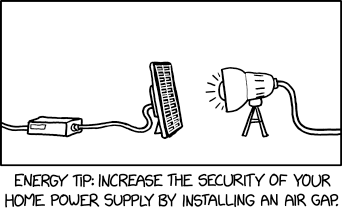
"Air Gap" (xkcd) - because "run it locally, keep it private, and stop assuming the public default path is acceptable" is quickly becoming the operator brief.
Image URL: https://imgs.xkcd.com/comics/air_gap.png
Post: https://xkcd.com/2651/