Here is what you missed while you were shipping.
Swarm Daily: Agent Adoption Now Depends on Admin Defaults
GitHub's org-level runner, firewall, instruction, and reporting controls plus JetBrains and Notion governance pushes show agent rollout is shifting from prompt craft to admin-managed defaults.
The Big Thing
The notable shift is not that agents can do more. It is that the rollout path is moving into org-wide defaults for where agents run, what they can reach, how they identify themselves, what instructions they inherit, and how admins measure use.
Why it matters: branch-first agent work is getting easier, but enterprise adoption still dies on boring questions. Can the agent run on approved infrastructure? Can it reach only sanctioned destinations? Will it satisfy signed-commit rules? Can admins set a baseline instruction set and see who is using which client version? Once those answers move into org settings, AI adoption stops being a power-user experiment and starts looking like normal platform rollout work.
- GitHub made the cloud agent branch-first on April 1, then quickly added org runner controls so admins can set a default execution environment across repositories and lock that choice when they need a consistent baseline. https://github.blog/changelog/2026-04-01-research-plan-and-code-with-copilot-cloud-agent/ https://github.blog/changelog/2026-04-03-organization-runner-controls-for-copilot-cloud-agent
- GitHub also moved the cloud agent firewall up to the organization layer, including org-wide defaults, a shared allowlist, and control over whether repository admins can add their own exceptions. https://github.blog/changelog/2026-04-03-organization-firewall-settings-for-copilot-cloud-agent
- Custom instructions are now generally available at the organization level across chat, code review, and cloud agent, while signed agent commits make automated work compatible with stricter branch protection rules. https://github.blog/changelog/2026-04-02-copilot-organization-custom-instructions-are-generally-available/ https://github.blog/changelog/2026-04-03-copilot-cloud-agent-signs-its-commits
- Usage reporting is moving up the stack too: GitHub now exposes per-user CLI activity, token use, and client-version detail in organization reports, which turns adoption into something teams can actually govern and budget. https://github.blog/changelog/2026-04-02-copilot-usage-metrics-now-includes-per-user-github-copilot-cli-activity-in-organization-reports/
- Outside GitHub, JetBrains Central is explicitly packaging policy enforcement, identity, auditability, and cost attribution for agent-driven development, while Notion added a workspace-wide consent rule for AI Meeting Notes. Different product, same direction: the admin baseline is becoming the adoption layer. https://blog.jetbrains.com/blog/2026/03/24/introducing-jetbrains-central-an-open-system-for-agentic-software-development/ https://www.notion.com/releases
Code & Tools
- Copilot SDK public preview - GitHub is exposing the same agent runtime behind Copilot as a programmable SDK for custom tools and workflows instead of forcing teams to rebuild session, tool-call, and approval plumbing. https://github.blog/changelog/2026-04-02-copilot-sdk-in-public-preview/
- Visual Studio custom agents and MCP governance - `.agent.md` files, reusable skills, and GitHub-backed MCP allowlists make team-specific agent behavior and data boundaries easier to standardize in repo-native form. https://github.blog/changelog/2026-04-02-github-copilot-in-visual-studio-march-update/
- Nuxt MCP Toolkit on Vercel - build MCP servers directly inside Nuxt apps with Zod validation, session persistence, inspector tooling, and a code mode that can orchestrate multiple tool calls in one execution. https://vercel.com/changelog
- `@workflow/serde` - custom class serialization for Vercel Workflow means durable steps can pass richer objects across boundaries instead of flattening everything into manual transport shapes. https://vercel.com/changelog
- `wrangler workflows --local` - Cloudflare now lets you manage the full Workflow lifecycle against a local `wrangler dev` session, which is the kind of boring-but-important operator loop long-running automation actually needs. https://developers.cloudflare.com/changelog/post/2026-04-01-wrangler-workflows-local/ https://developers.cloudflare.com/workflows/build/local-development/
Tech Impact
- The first serious AI rollout checklist will look more like platform governance than prompt engineering. Approved runners, signed commits, firewall defaults, MCP allowlists, and inherited instructions will become the gating artifacts before broad access gets approved. https://github.blog/changelog/2026-04-03-organization-runner-controls-for-copilot-cloud-agent https://github.blog/changelog/2026-04-02-github-copilot-in-visual-studio-march-update/
- Shared defaults will matter more than local heroics. Once admins can set the baseline once and see user-level usage, wildcard experiments and stale clients become operational debt instead of innovation. https://github.blog/changelog/2026-04-02-copilot-organization-custom-instructions-are-generally-available/ https://github.blog/changelog/2026-04-02-copilot-usage-metrics-now-includes-per-user-github-copilot-cli-activity-in-organization-reports/
- The vendors that win enterprise agent adoption will be the ones that turn guardrails into defaults instead of documentation. JetBrains and Notion are different products, but both are converging on the same lesson: governance has to ship inside the product, not in a PDF after the fact. https://blog.jetbrains.com/blog/2026/03/24/introducing-jetbrains-central-an-open-system-for-agentic-software-development/ https://www.notion.com/releases
Meme of the Day
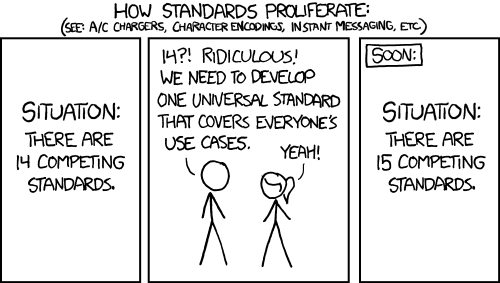
"Standards" (xkcd) - because every agent rollout eventually reaches the phase where the team tries to solve prompt drift by inventing one more universal policy surface.
Image URL: https://imgs.xkcd.com/comics/standards.png
Post: https://xkcd.com/927/