Here is what you missed while you were shipping.
Swarm Daily: The Runtime Is Becoming the Safety System
Sandboxes, egress controls, and isolated validation loops are turning AI-generated code into a runtime policy problem instead of a prompt-quality problem.
The Big Thing
The safest agent stack is increasingly the one with the best runtime boundaries, not the one with the biggest prompt library.
Why it matters: generated code now gets to run earlier in the loop. It can call APIs, inspect repos, execute builds, and propose fixes before a human reviews the output. That shifts the operator job from "did the model reason well?" to "what can this runtime reach, what secrets can it actually use, and what proof must it produce before it gets write authority?" The pattern showing up across vendors is consistent: isolated compute, explicit outbound policy, host-mediated access to internal systems, and validation before action.
- Deno is treating LLM-written code as an egress and secret-exfiltration problem, not just an isolation problem. Deno Sandbox runs code in Linux microVMs, keeps secrets out of the environment, materializes the real key only on requests to approved hosts, and blocks unlisted destinations with
allowNet. https://deno.com/blog/introducing-deno-sandbox https://deno.com/sandbox - GitHub is packaging the same idea at the workflow layer. Agentic Workflows run with read-only permissions by default and route writes through preapproved safe outputs, with sandboxed execution, network isolation, and SHA-pinned dependencies built into the model. https://github.blog/changelog/2026-02-13-github-agentic-workflows-are-now-in-technical-preview https://github.blog/ai-and-ml/automate-repository-tasks-with-github-agentic-workflows
- Cloudflare is doing it inside code execution itself. The new
DynamicWorkerExecutorblocksfetch()andconnect()by default withglobalOutbound: null, which means generated code can only reach the host through explicit tool calls unless an operator opens a controlled outbound path. https://developers.cloudflare.com/changelog/post/2026-02-20-codemode-sdk-rewrite/ https://developers.cloudflare.com/agents/api-reference/codemode/ - Cloudflare is also moving secret and binding access out of the sandbox. Containers and Sandboxes can now call Workers functions, KV, and R2 over internal HTTP hostnames, so the mediation layer lives in the Workers runtime instead of inside the container process. https://developers.cloudflare.com/changelog/product/containers/
- OpenAI is reinforcing the same standard on security workflows. Codex Security validates potential vulnerabilities in an isolated environment before surfacing a finding or proposed patch, so human review starts after reproduction, not before. https://help.openai.com/en/articles/20001107-codex-security
Code & Tools
- Deno Sandbox - host-scoped secrets, outbound allowlists, and direct deploy-from-sandbox make it a clean reference design for running generated code with real credentials. https://deno.com/blog/introducing-deno-sandbox https://deno.com/sandbox
- Cloudflare Codemode +
DynamicWorkerExecutor- generated code can orchestrate tools inside an isolated runtime where outbound traffic is denied by default and only re-enabled through an explicit fetcher. https://developers.cloudflare.com/changelog/post/2026-02-20-codemode-sdk-rewrite/ https://developers.cloudflare.com/agents/api-reference/codemode/ - Cloudflare outbound Workers for Containers and Sandboxes -
outboundByHostturns internal hostnames into controlled calls to Worker code, KV, or R2, which is exactly the kind of host-mediated bridge AI runtimes need. https://developers.cloudflare.com/changelog/product/containers/ - GitHub Agentic Workflows - Markdown-defined repository automations now ship with read-only defaults, network isolation, and safe outputs, which makes the guardrails part of the workflow surface instead of an afterthought. https://github.blog/changelog/2026-02-13-github-agentic-workflows-are-now-in-technical-preview
- Cloudflare sandbox state primitives -
sandbox.watch()streams file events over SSE andcreateBackup()/restoreBackup()brings warm workspaces back without rerunning setup, which makes long-running agent loops cheaper and faster. https://developers.cloudflare.com/changelog/post/2026-03-03-sandbox-watch-file-events/ https://developers.cloudflare.com/changelog/post/2026-02-23-sandbox-backup-restore-api/
Tech Impact
- Egress policy becomes the new IAM edge for agents. Once secrets are injected only on approved destinations and outbound traffic is deny-by-default, the real permission model moves from environment variables to network policy. https://deno.com/blog/introducing-deno-sandbox https://developers.cloudflare.com/agents/api-reference/codemode/ https://developers.cloudflare.com/changelog/product/containers/
- Validation sandboxes will sit between reasoning and write authority. Teams will increasingly ask agents to reproduce a vuln, pass a fix check, or prove a workflow path in isolation before they get merge, deploy, or remediation rights. https://help.openai.com/en/articles/20001107-codex-security https://github.blog/changelog/2026-02-13-github-agentic-workflows-are-now-in-technical-preview
- Warm sandbox state will separate serious platforms from demos. Snapshots, backups, and live file events cut enough cold-start friction that long-running agent loops can feel operational instead of theatrical. https://developers.cloudflare.com/changelog/post/2026-02-23-sandbox-backup-restore-api/ https://developers.cloudflare.com/changelog/post/2026-03-03-sandbox-watch-file-events/ https://deno.com/blog/introducing-deno-sandbox
Meme of the Day
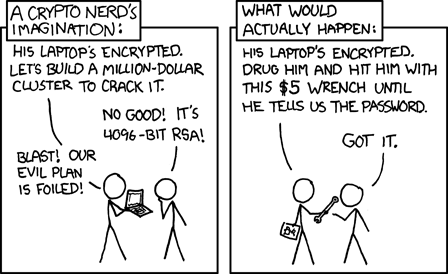
"Security" (xkcd) - because every "fully isolated" agent is one outbound allowlist mistake away from becoming the incident review.
Image URL: https://imgs.xkcd.com/comics/security.png
Post: https://xkcd.com/538/